
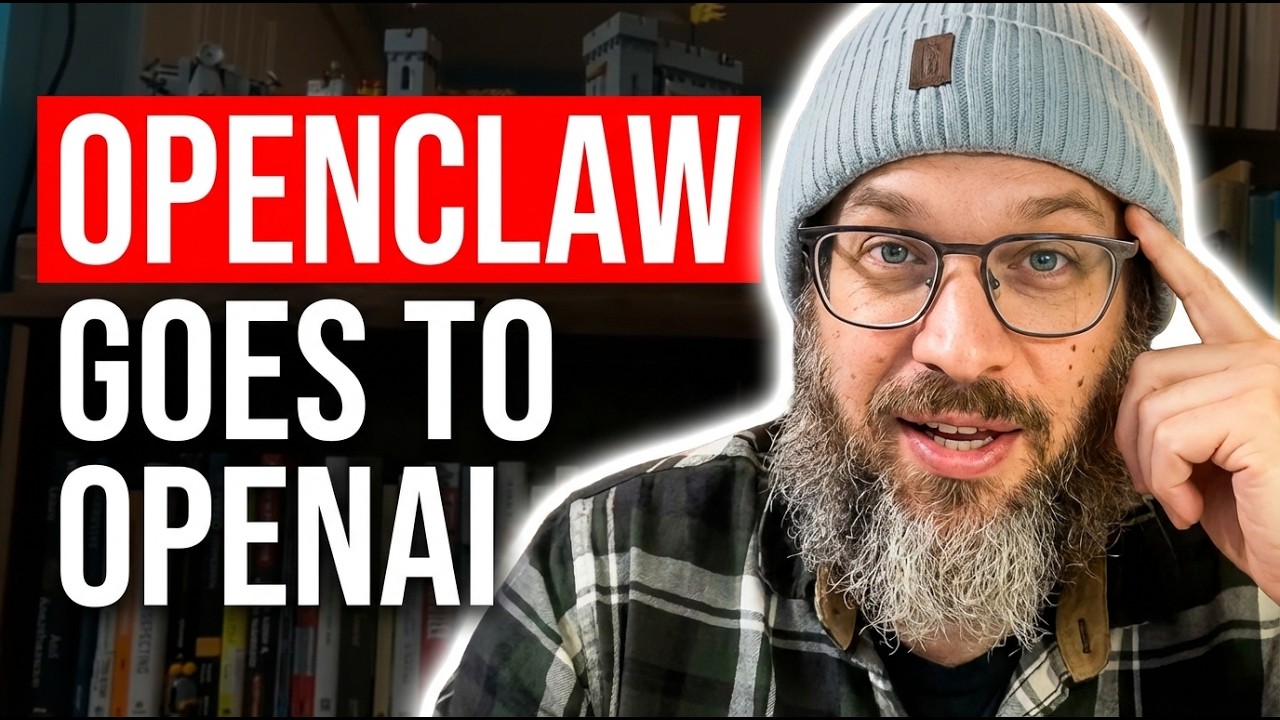
Paul’s Perspective:
This matters to operators because the agent era will reshape competitive advantage the same way mobile and cloud did: whoever owns the underlying platform gets leverage on distribution, developer mindshare, and enterprise adoption. If your business is betting on automation, copilots, or AI-driven workflows, you’ll want to track which platforms become the default rails—and how open-source projects, security posture, and governance decisions upstream can create risk or lock-in downstream.
Key Points in Video:
- The project highlighted hit roughly 200,000 GitHub stars and is framed as the fastest-growing open-source project in GitHub history.
- The creator was reportedly carrying costs of about $20,000 per month while scaling the project.
- More than 40 security patches were shipped just days before the announcement, implying significant operational and security knowledge transfer.
- The story contrasts an “acqui-hire” narrative with a deeper platform play, using the Chrome/Chromium model as an analogy for how open ecosystems get shaped and controlled.
Strategic Actions:
- Assess why top builders are choosing specific AI platforms (compute, distribution, autonomy, and ability to ship).
- Track the open-source project signals: adoption velocity (stars), contributor momentum, and ecosystem pull.
- Use the Chrome/Chromium pattern to evaluate how “open” projects may still centralize control through hosted services and default integrations.
- Scrutinize operational readiness by looking at pre-announcement hardening (e.g., security patch volume and timing).
- Plan for the shift from chat interfaces to personal agents that execute work on real computers and systems.
- Map who is likely to own the “foundation layer” beneath agents in your stack, and what that means for cost, security, and vendor leverage.
The Bottom Line:
- A high-profile open-source creator choosing OpenAI over Meta signals where the agent platform layer is consolidating power and talent.
- As software shifts from chatbots to agents that operate real computers, the biggest strategic question becomes who controls the foundation those agents run on.
Dive deeper > Source Video:
Ready to Explore More?
If you’re deciding where AI agents fit in your operations and what platforms to standardize on, we can help you pressure-test the options and build a practical rollout plan. Our team works alongside yours to reduce risk, tighten security, and turn automation into measurable productivity gains.