
Paul’s Perspective:
If you treat AI agents like interchangeable copilots, you’ll pick tools that clash with your security posture, accountability requirements, and how work actually flows in your business. Leaders who evaluate agents by control, autonomy, and go-to-market placement will standardize faster, avoid expensive re-platforming, and delegate the right work to automation without delegating away responsibility.
Key Points in Video:
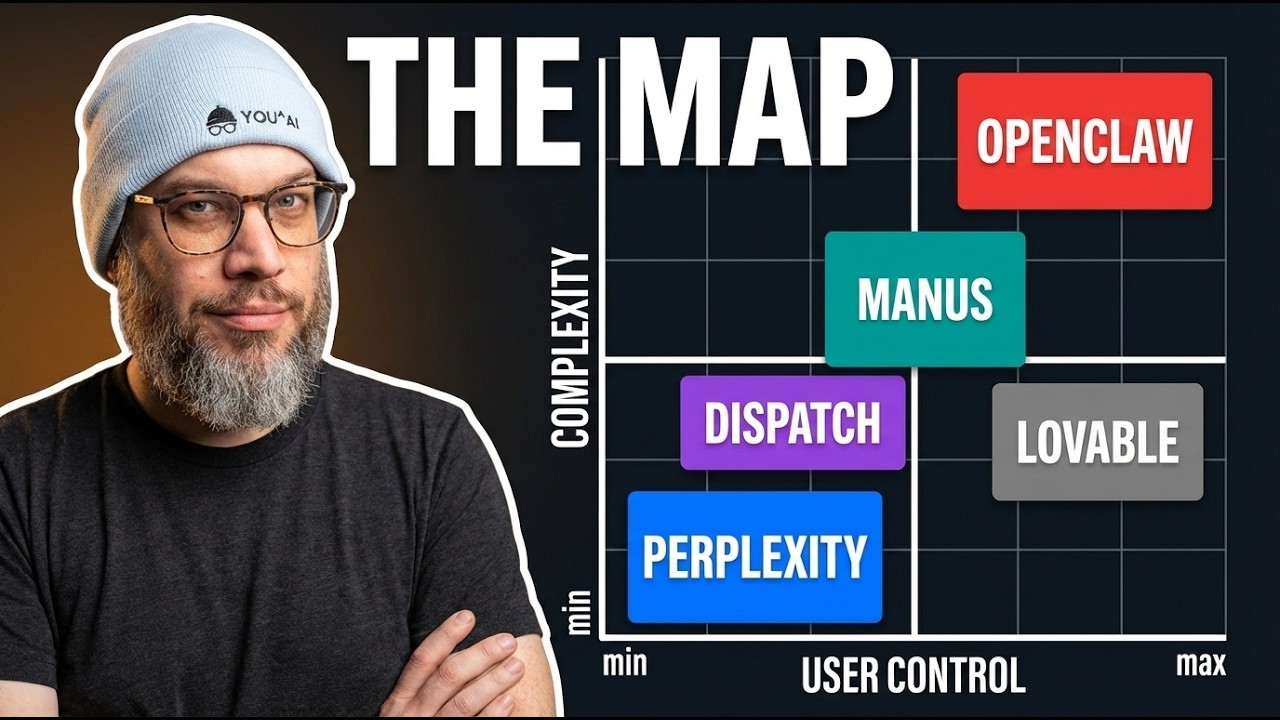
- Assess agents on three strategic axes: sovereignty (who controls data/workflows), delegation (how much autonomy you hand over), and distribution (how the product reaches users).
- Different launches map to different plays: a sovereignty-first approach prioritizes control/security; delegation-first prioritizes end-to-end task execution; distribution-first prioritizes embedding agents where users already are.
- Security and trust are first-order constraints: your acceptable risk level determines whether an agent can touch customer data, financial workflows, or internal systems.
- Expect “compression” (relentless simplification): many features and standalone tools will get absorbed into a few dominant surfaces, changing vendor leverage and pricing power.
Strategic Actions:
- Ignore the “horse race” narrative and identify the strategic bet behind each agent launch.
- Evaluate any agent using three axes: sovereignty, delegation, and distribution.
- Define your required level of sovereignty (data residency, auditability, control of workflows) before testing tools.
- Decide what you’re willing to delegate (recommendations vs. execution) and where humans must stay in the loop.
- Validate distribution fit: where will the agent live day-to-day (browser, OS, chat surface, internal app stack) and how will users adopt it.
- Stress-test trust and security for the specific workflows you want to automate (customer data, payments, approvals, credentials).
- Plan for simplification/compression: pick bets that will survive consolidation, not just this quarter’s feature set.
The Bottom Line:
- AI agent products aren’t all chasing the same goal; they’re making fundamentally different bets that change what you can safely delegate, where data lives, and how work gets done.
- Using three evaluation axes, you can cut through hype and make clearer build-vs-buy decisions that will shape your operating model over the next few years.
Dive deeper > Source Video:
Ready to Explore More?
If you want a practical way to score AI agents against your security, processes, and ROI targets, our team can help you set evaluation criteria and run a structured pilot. We’ll work with you to choose what to buy, what to build, and what not to delegate.