
Paul’s Perspective:
This matters because local AI is moving from niche experimentation to a viable operating model for organizations that need speed, control, and data privacy. If your team is evaluating where AI should run, these desktop-class systems change the economics and governance conversation in a meaningful way.
Key Points in Video:
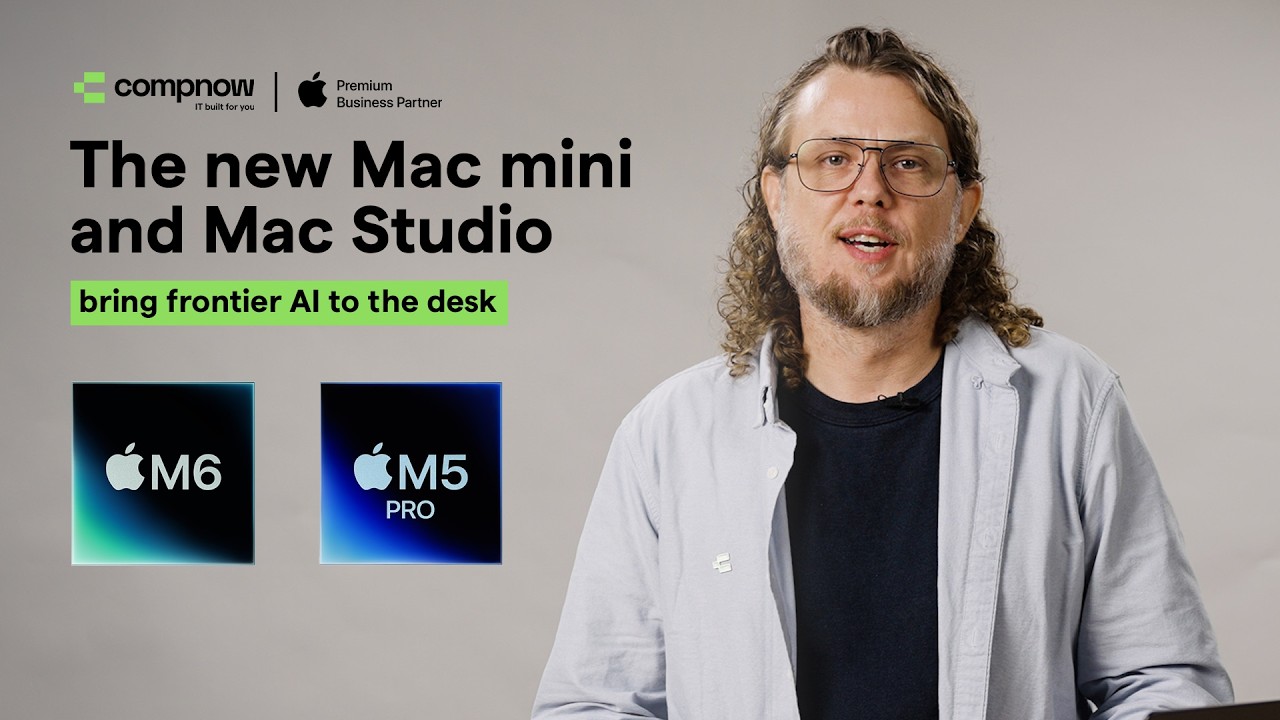
- The new Mac mini with M6 uses a 2-nanometer process, offers 12 CPU cores and 12 GPU cores, and delivers a 20% uplift over M5.
- M6 also adds a dual 16-core Neural Engine with a 30% increase in peak AI compute and 170GB/s memory bandwidth.
- The M5 Pro Mac mini scales up to 18 CPU cores, 20 GPU cores, 64GB unified memory, and 307GB/s bandwidth for larger local models and agents.
- The M5 Ultra Mac Studio reaches up to 36 CPU cores, 80 GPU cores, 1.2TB/s memory bandwidth, and 512GB unified memory, with up to 4.5x the peak GPU compute of M3 Ultra.
- Up to four Macs can be clustered over Thunderbolt 5, creating a combined memory pool of as much as 2TB for larger on-device AI workloads.
Strategic Actions:
- Assess which AI workloads can move from cloud services to local devices based on privacy, latency, and cost.
- Match system choice to workload size, from everyday AI use on Mac mini to larger professional and model workloads on Mac Studio.
- Evaluate memory, bandwidth, and unified memory requirements before selecting M6, M5 Pro, M5 Max, or M5 Ultra configurations.
- Consider clustering multiple Macs over Thunderbolt 5 if you need larger shared memory for frontier-class local models.
- Compare long-term cloud token costs against a local AI deployment model that includes governance and data sovereignty benefits.
- Plan around the September 22 ship date and any downstream OS roadmap implications for deployment timing.
The Bottom Line:
- Apple’s latest Mac mini and Mac Studio push high-end AI workloads onto the desktop with major gains in CPU, GPU, memory bandwidth, and unified memory capacity.
- For businesses and institutions, that creates a more practical path to running local AI with better privacy, governance, and potentially lower long-term costs than cloud-heavy approaches.
Dive deeper > Source Video:
Ready to Explore More?
If you’re weighing local AI, Apple silicon, or the right deployment model for your team, we can help assess the tradeoffs and map out a practical plan. Our team works together to align the technology choice with security, operations, and business value.