
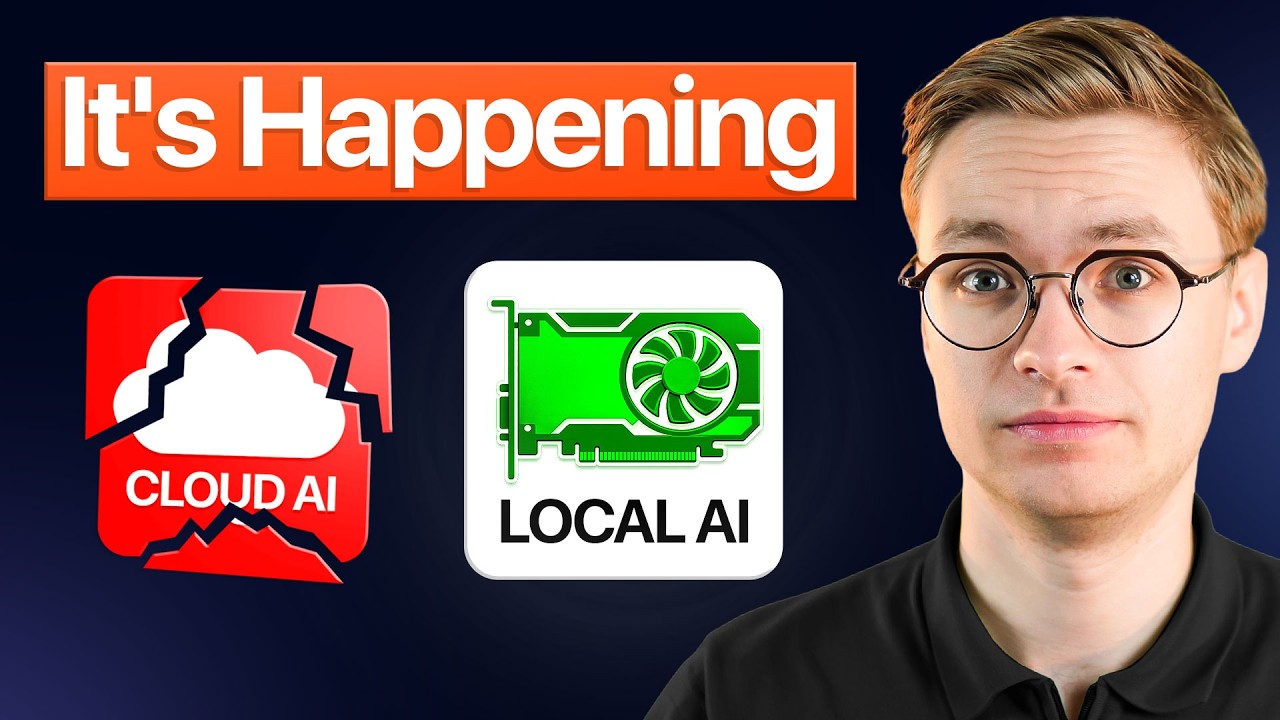
Paul’s Perspective:
Local AI matters because it turns AI from a generic “prompting” skill into an operational capability: running models reliably, securely, and cost-effectively where the data lives. For business leaders, that’s the difference between isolated experiments and deployable systems that survive audits, meet privacy requirements, and deliver predictable unit economics.
Key Points in Video:
- Hands-on testing across 14 local AI use cases on an RTX 5090 found only 3 that matched or beat cloud options: code autocomplete, speech-to-text (Whisper), and image generation.
- Workload “repatriation” is accelerating: about 80% of enterprises are pulling some AI workloads back from cloud to local/edge environments.
- Developer adoption outpaces integration capability: 84% use AI tools, but only 18% build AI integrations.
- Regulatory and risk pressure is a major driver: GDPR fines have reached €5.88B, pushing companies toward architectures that reduce data exposure.
Strategic Actions:
- Compare local vs. cloud AI by use case, measuring latency, quality, cost, and operational complexity.
- Prioritize the local workloads that consistently perform well (code autocomplete, speech-to-text, image generation).
- Adopt a hybrid architecture: keep sensitive or high-frequency tasks local, and route bursty or frontier-model needs to the cloud.
- Design for compliance and risk reduction (data residency, access controls, logging, retention) before scaling usage.
- Close the integration gap by productizing AI into workflows (APIs, agents with guardrails, and monitored pipelines) instead of standalone tools.
- Stand up a starter local stack (Ollama or LM Studio, Continue Dev, and Faster Whisper) and iterate from pilot to production.
The Bottom Line:
- Enterprise AI is shifting back to on-prem and edge, creating demand for people who can deploy and run models on company hardware under real compliance and security constraints.
- That skill gap can translate into stronger career leverage and pay, with AI skills tied to 56% higher wages and an edge AI market projected to grow from $25B (2025) to $143B by 2034.
Dive deeper > Source Video:
Ready to Explore More?
If you’re deciding what should run locally vs in the cloud, we can help your team map the use cases, compliance requirements, and ROI, then build a practical hybrid plan. We’ll work alongside your IT and business leaders to get a pilot into production without adding unnecessary complexity.